|
|
#1 | |
|
Council Member
Join Date: May 2006
Location: Calcutta, India
Posts: 936
|
Quote:
Given the current international geostrategic environment and alignments, what could be the solution? Further, would it be another strategic blunder for India like Aksai Chin and Tibet? Last edited by Ray; 03-30-2008 at 09:00 AM. |
|
|
|
|
|
|
#2 |
|
Council Member
Join Date: Jan 2011
Posts: 83
|
The Siachen Conflict, sometimes referred to as the Siachen War, is a military conflict between India and Pakistan over the disputed Siachen Glacier region in Kashmir. The conflict began in 1984 with India's successful Operation Meghdoot during which it wrested control of the Siachen Glacier from Pakistan and forced the Pakistanis to retreat west of the Saltoro Ridge. India has established control over all of the 70 kilometres (43 mi) long Siachen Glacier and all of its tributary glaciers, as well as the three main passes of the Saltoro Ridge immediately west of the glacier—Sia La, Bilafond La, and Gyong La. Pakistan controls the glacial valleys immediately west of the Saltoro Ridge.[2][3] According to TIME magazine, India gained more than 1,000 square miles (3,000 km2) of territory because of its military operations in Siachen.[4]
http://en.wikipedia.org/wiki/Siachen_conflict http://outsideonline.com/outside/fea...siachen_1.html http://www.time.com/time/asia/covers...11/story3.html |
|
|
|
|
|
#3 |
|
Council Member
Join Date: Mar 2006
Location: UK
Posts: 6,116
|
The Siachen conflict certainly fits a 'Small War' label, although I find it hard to think of anywhere so inhospitable to contemporary human settlement, let alone a war and I've been in the Dolomites where in WW1 there was a gruelling, bloody conflict.
Thankfully there has been a ceasefire since 2005 (from Wikipedia), although a political settlement is far off I would say. I do recall newsreel from each side beforehand making an occasional appearance here, invariably of artillery duels. It is only when you read up on India's military position and appreciate the geography along its northern borders why it is so sensitive to what happens. The IISS Military Balance shows numerous specialist para-military forces and ten mountain infantry divisions. Now we tend to forget the shock to India when China (PRC) in 1962 launched an offensive and the response by others - the UK considered offering a nuclear "umbrella" to India. Background reading on conflict:http://en.wikipedia.org/wiki/Sino-Indian_War
__________________
davidbfpo |
|
|
|
|
|
#4 |
|
Council Member
Join Date: May 2006
Location: Calcutta, India
Posts: 936
|
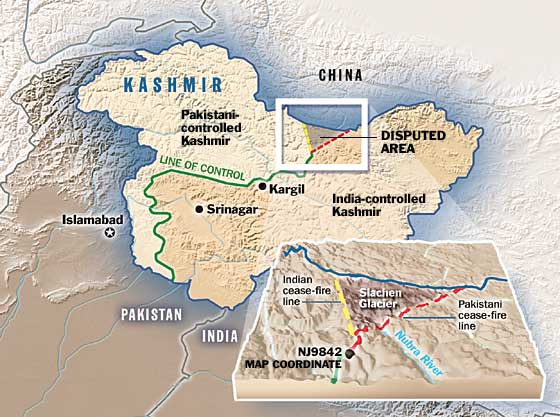
Actually, India did not wrest the Siachen.
It was unoccupied. Pakistan Govt was granting passes for Mountaineering Expeditions in this area and thus defacto attempting to establish that this area was under Pakistan, which was a incorrect premise of Pakistan. The then Army Commander, Northern Command, after getting Govt permission, ordered occupation of the Siachen Glacier with 5 KUAMAON. ![]() There is an opinion that is bandied that The Siachen Glacier has no significant strategic value. The map would indicate that there is. More so, these days where Pakistan has ceded the Shaksgam Valley. Shaksgam Valley is bounded by the Kun Lun Mountains to the north, and by the Karakoram peaks to the south, including Broad Peak, K2 and Gasherbrum. On the southeast it is adjacent to the highest battlefield in the world in the Siachen Glacier region. http://simple.wikipedia.org/wiki/File:Shaksgam.png It is worth considering as to why China wanted Shaksgam Valley and why Pakistan ceded it from all points of view, including strategic. If India had not held Siachen, it would have been a free run for both Pakistan or China or both in collusion to roll down to Leh. Presently India holds all of the glacier and commands the top of all three passes. Pakistan formerly controled Gyong La at 35-10-29N 77-04-15E that overlooks the Gyong (tributary of the Shyok) and Nubra River Vallies and India's access to Leh District. The Prime Minister of India, Manmohan Singh's idea of making Siachen a 'zone of peace' and withdraw troops is misplaced, unless it follows the principle, 'peace at all costs'. That this idea of Siachen being a 'zone of peace' is flawed and dangerous is because once the Indian troops are withdrawn to Leh, the three stage acclimatisation will be essential if the Siachen has to be reoccupied in case Pakistan rushes in to occupy. And Pakistan is known to renegade with impunity all treaties and understandings (the latest being Osama not being in Pakistan). It maybe known access from the Pakistani side is relatively easier. There is also no guarantee that Siachen is not ceded by Pakistan to China to make a continuous landmass from Chinese Occupied Aksai Chin to the Shaksgam Valley and then virtually opening up Leh and beyond. Last edited by Ray; 05-03-2011 at 01:47 PM. |
|
|
|
|
|
#5 | |
|
Council Member
Join Date: May 2006
Location: Calcutta, India
Posts: 936
|
Is the Pakistan Army brave enough to make peace?
Quote:
|
|
|
|
|
|
|
#6 | |
|
Council Member
Join Date: May 2006
Location: Calcutta, India
Posts: 936
|
Quote:
|
|
|
|
|
|
|
#7 |
|
Council Member
Join Date: May 2006
Location: Calcutta, India
Posts: 936
|
![]() The roots of the conflict over Siachen lie in the non-demarcations on the western side of the map beyond a grid point known as NJ 9842. Hostilities between India and Pakistan over ownership of the Glacier date back to the first Indo-Pak war of 1948, over the territorial dispute of Jammu & Kashmir. A Cease-Fire Line (CFL) was established as a result of the 1949 Indo-Pak agreement that concluded the war in Jammu & Kashmir. The CFL ran along the international Indo-Pak border and then north and northeast until map grid-point NJ 9842, located near the Shyok River at the base of the Saltoro mountain range. Because no Indian or Pakistani troops were present in the geographically inhospitable northeastern areas beyond NJ 9842, the CFL was not delineated as far as the Chinese border. Both sides agreed, in vague language, that the CFL extends to the terminal point, NJ 9842, and "thence north to the Glaciers". India's 'North' lies along the ridgeline North (yellow line) and Pakistan's 'North' goes North East (red line)! |
|
|
|
|
|
#8 | |
|
Council Member
Join Date: May 2006
Location: Calcutta, India
Posts: 936
|
The version from Pakistan
The fight for Siachen By Javed Hussain (a retired Brigadier of the SSG) Published in The Express Tribune(a Pakistani newspaper): April 22, 2012 Quote:
Going East instead of North would mean it is Pakistan's! Last edited by Ray; 04-23-2012 at 06:19 AM. |
|
|
|
|
|
|
#9 | |
|
Council Member
Join Date: Mar 2006
Location: UK
Posts: 6,116
|
Taken from an email from Hamid Hussain, who contributes to SWC / SWJ indirectly:
Quote:
__________________
davidbfpo |
|
|
|
|
|
|
#10 | |
|
Council Member
Join Date: May 2006
Location: Calcutta, India
Posts: 936
|
Quote:
BTW, there is a Waiting List amongst officers and men of the Indian Army who want a tenure in these 'God forsaken mass of ice and snow'. If India demilitarises this area and then Pakistan surreptitiously occupies the same (as they did in Kargil inspite of a delineated Line of Control signed by both the countries), then there is no hope in hell for the Indian Army to regain the same. If Pakistan occupies it then there would be a continuous stretch of landmass from the Shaksgam (which Pakistan ceded to China) -Siachen- Aksai Chin. As it is China has troops and influence in Pakistan Occupied Kashmir. Freedom is expensive, but every pain and sorrow is worth the joy to be a free people of a democracy that has never seen any interruption by non political players. Last edited by Ray; 05-07-2012 at 04:26 AM. |
|
|
|
|
|
|
#11 | |
|
Council Member
Join Date: Oct 2005
Posts: 1,844
|
Posted by Ray,
Quote:
On a related note, what role do you think China will play in Afghanistan after U.S. forces leave? What has been their historic role in Afghanistan if any? |
|
|
|
|
|
|
#12 | ||
|
Council Member
Join Date: May 2006
Location: Calcutta, India
Posts: 936
|
Quote:
The Chinese claim they are Engineers who are helping Pakistan with their projects. However, many long tunnels have been spotted in the area. http://articles.economictimes.indiat...ok-yang-jiechi It was first reported in the New York Times. China has an interest in the Central Asia Republics. It is said that she has plans to build railway links to these countries and to Afghanistan and also Iran. India has built the Chahbahar port in Iran and has linked it to the road made by India in Western Afghanistan (zaranj-delaram ). There are reports in the Pakistani media that Iran is opening up the Indian made port Chahbahar for NATO supplies. http://www.pakistankakhudahafiz.com/...aranj-delaram/ It is a bit surprising that Iran will allow transit of NATO supplies to Iran, but if read in context with the link below, it makes some sense. Quote:
http://www.hindustantimes.com/India-...e1-763448.aspx Therefore, there are too many fingers in the pie to really be able to know how too many cooks can spoil the broth!
Last edited by davidbfpo; 05-08-2012 at 08:10 AM. Reason: Parts of this hread on logistics were copied to he Afg logistics thread yesterday |
||
|
|
|
|
|
#13 | |
|
Council Member
Join Date: May 2006
Location: Calcutta, India
Posts: 936
|
Quote:
Last edited by Ray; 05-08-2012 at 04:32 AM. |
|
|
|
|
|
|
#14 | |
|
Council Member
Join Date: May 2006
Location: Calcutta, India
Posts: 936
|
Quote:
|
|
|
|
|
|
|
#15 |
|
Council Member
Join Date: May 2006
Location: Calcutta, India
Posts: 936
|
Pakistan's glacier disaster: fallout yet to be felt
For the Pakistan Army, the high costs have to be borne and are worth it. The Army accords the highest priority to the civilian relatives of the soldiers posted in this area. As these people are essential to the morale in the armed forces, the Pakistan Army spares no effort to keep them happy. The 6 NLI (Northern Light Infantry) of the Pakistani Army has many Shias from the Gilgit-Baltistan region and it played a key role in the Kargil War. Yet, despite everything that the NLI did in Kargil, the Pakistani Army sought to deny the involvement of this unit in the war. In order to support the fiction that Kargil was the work of Kashmiri separatists, the Pakistan Army initially refused to accept the bodies of dead NLI soldiers from India. Quite naturally, there was great anger in the region and the Pakistan Army backpedalled. It converted the NLI into a regular infantry unit and awarded its war dead proper recognition by conferring posthumous gallantry awards and other honors. Because of this history, today, until the bodies of the buried NLI soldiers are found and returned with honour to the families, the animosity and latent hostility towards the Pakistan Army in the region will remain. Usually, after a natural disaster in Pakistan, international donors pour in aid money. These funds are deftly sucked up by corrupt Army men and politicians. Unfortunately for Ghyari, there are no international donors. The only funds -- when provided -- are likely to come from the emergency funds in the Pakistani treasury. This is as bad an option, as Pakistan constantly risks defaulting on its international debt obligations. Digging into the civilian budget to respect General Ashfaq Parvez Kayani’s vow of recovering every body will make the politicians very unhappy and could lead to internal fights. The financial costs aren’t quite as acceptable to the civilians. As the realisation that Pakistan spends a much higher fraction of its GDP on the Saltoro war than India slowly sinks into the public mind, a cascading blame-game will begin. At present, the Pakistan Army may come across as a more caring and sensitive entity than its civilian counterparts, but deeper questions about the exact nature of accountability in the country are likely to surface in the internal debate. Given the terrible state of the economy, it is only natural for the civilian leadership to ask whether or not to incur the costs of rebuilding the capacity lost at Ghyari -- and such a question will be the veritable red rag for the bruised Pakistan Army. A bruised Pakistan Army ego may seek to redeem itself by resorting to intimidation and putting the civilian politicians in their place with a coup or pull another utterly unnecessary Kargil-style stunt on the Saltoro range. Either way this plays out, given the state of the Pakistani economy, it is difficult to a see a future where the Ghyari disaster does not exacerbate civil-military tensions in Pakistan and adversely affect the peace process with India. New Delhi’s initiatives on Siachen should take Ghyari-related developments into account. http://southasiamonitor.org/detail.php?type=sl&nid=2700 |
|
|
|
![]() |
| Bookmarks |
| Thread Tools | |
| Display Modes | |
|
|