SMALL WARS COUNCIL
Go Back   Small Wars Council > Conflicts -- Current & Future > Other, By Region > Africa

Reply
 
Thread Tools Display Modes
Old 08-22-2012   #361
JMA
Council Member
 
Join Date: Mar 2010
Location: Durban, South Africa
Posts: 3,213
Default Rhodesian Drake Shoot

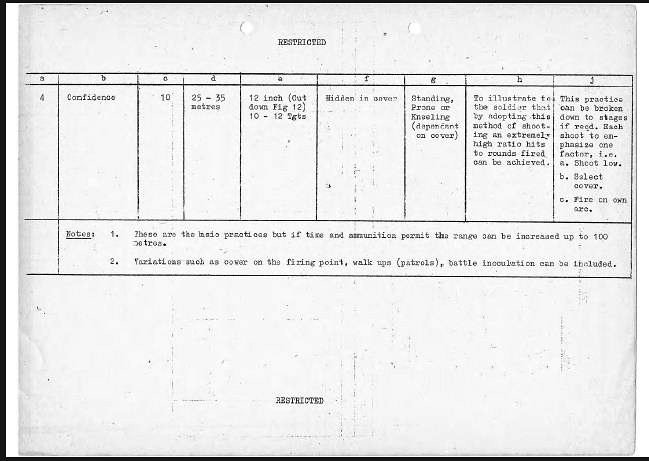
Officially known as the Transitional Shoot was an essential part of the ongoing shooting training for trained soldiers.

Quote:
RHODESIAN TRANSITIONAL SHOOT
(aka Drake Shoot)

INTRODUCTION

1. During most contacts a low rate of kills is being achieved to the number of rounds fired. For example after one engagement it was reported that a platoon fired approximately eleven hundred rounds and achieved no kills or hits despite the fact that the contact took place at a range of less than thirty yards. Examination of the contact area later revealed that the majority of shots fired by the security forces were high, this was borne out by the amount of damage to trees in the vicinity. Most rounds had struck foliage three to four feet above ground level.

2. From those observations it would appear that whilst it is possible to train a soldier to a high standard of shooting on the range it does not necessarily follow that he is automatically able to apply the lessons learnt when he comes under fire in battle.

This lack of application can be put down to two basic reasons:

a. A failure to relate his weapon training lessons to fieldcraft.

b. A natural nervousness due to stresses created by battle conditions.

AIM

3. The aim of this range practice is to teach soldiers to relate field craft and ground appreciation to good shooting under realistic conditions.

METHOD

4. The basic faults to overcome are:

a. A tendency to fire high. This is a result of firing range practice at comparatively large figure targets mounted approximately six feet above ground level. The terrorist will usually be at ground level and will present a target no higher than twelve inches.

b. Failure to fire at potential enemy cover. Soldiers nust appreciate the ground, and fire at likely enemy positions, WHETHER THEY CAN SEE MEN THERE OR NOT. Logs, bushes, tree trunks and folds in the ground all provide likely cover, the high velocity 7,62mm round will penetrate most natural cover at close range!

c. Tendency to concentrate fire on the most likely position. If a terrorist is visible or isolated cover suggests more likely position, there is a tendency for all to fire in one direction. This results in the arc to the front not being fully covered and although one terrorist may be well and truly dealt with, several others in less obvious fire positions will remain unscathed and potentially dangerous.

5. To summarise, a soldier must be taught and practised to:

a. Fire low, no higher than 9 - 12 inches above the estimated ground level.

b. Select and fire at likely enemy fire positions remembering to relate his field craft to his shooting.

c. Fire at the enemy within his own particular arc to his front and not to be drawn to fire at obvious targets already covered by others within his fire unit.

RESULT

6. This dootrine has been tried and proven. A platoon trained on the lines described above engaged terrorists in three separate contacts in one day, resulting in:

a. Four terrorists killed.

b. Two seriously wounded (one suffered 10 hits).

c. Five captured.

d. A total ammunition expenditure during the whole day of 250 rounds and one grenade.

PRACTICES

7. The following practices are best fired on field firing ranges or in jungle lane areas but can be adapted to classification or transitional ranges by the provision of artificial cover.

8. This shoot should be fired by all soldiers at the completion of recruit training and Practice 3, with variations, by trained soldiers at every available opportunity.


__________________
"The highest generalship is to compel the enemy to disperse his army, and then to concentrate superior force against each fraction in turn." - Col. Henderson, George Francis Robert (1854-1903)
JMA is offline   Reply With Quote
Old 08-22-2012   #362
Fuchs
Council Member
 
Fuchs's Avatar
 
Join Date: May 2008
Location: Germany
Posts: 2,975
Default

Quote:
7,62mm round will penetrate most natural cover at close range!
Not sure about British English, but that's not possible in American English (or only DOD speak).
The supposed "cover" would in American English only qualify as "concealment".

It's noteworthy that Germans don't properly differentiate between the two either. "Deckung" and "Sichtschutz" are different things tactically, and this should be better appraised. We talk too often about "Deckung" instead.


http://www.scribd.com/doc/2472256/Ar...ent-and-Decoys
(I would have sworn that the "D" in "CCD" was about "deception", maybe in an earlier FM version?)
Fuchs is offline   Reply With Quote
Old 08-23-2012   #363
JMA
Council Member
 
Join Date: Mar 2010
Location: Durban, South Africa
Posts: 3,213
Default

Quote:
Originally Posted by Fuchs View Post
Not sure about British English, but that's not possible in American English (or only DOD speak).
The supposed "cover" would in American English only qualify as "concealment".

It's noteworthy that Germans don't properly differentiate between the two either. "Deckung" and "Sichtschutz" are different things tactically, and this should be better appraised. We talk too often about "Deckung" instead.


http://www.scribd.com/doc/2472256/Ar...ent-and-Decoys
(I would have sworn that the "D" in "CCD" was about "deception", maybe in an earlier FM version?)
Yes obviously then the British use of the word covers a wider definition.

"Cover" in general terms is in relation to observation and enemy fire.

In the instance of a contact it would follow that if you seek cover from enemy fire you will not be able to take part in the fire fight or play only a limited part in it.

(As an aside here the fieldcraft lesson "Selecting lines of advance" would, if the lesson was adhered to, make sure that a stick/fire team/squad/section were not totally caught out in the open or in a disadvantageous tactical position. Accepting that operations in jungle and thick bush limit your options for tactical movement somewhat.)

The training in response to receiving the order "Take Cover" is to "Dash, down, crawl, observe, sights, fire." Remembering to change your firing position often.

So unless your intention is to "hide", cover would generally relate to cover from enemy observation. Folds in the ground may afford partial cover from enemy fire but your head, arms and weapon would need to exposed... preferably behind something providing cover from direct enemy observation.

The aim of the Transitional (Drake) Shoot is to improve the effectiveness of selecting and firing into likely cover (behind which the enemy may be lurking) during a contact while winning the fire fight. Or as the document on the shoot stated:

Quote:
The aim of this range practice is to teach soldiers to relate field craft and ground appreciation to good shooting under realistic conditions.
Don't let semantics distract you.
__________________
"The highest generalship is to compel the enemy to disperse his army, and then to concentrate superior force against each fraction in turn." - Col. Henderson, George Francis Robert (1854-1903)
JMA is offline   Reply With Quote
Old 01-23-2013   #364
davidbfpo
Council Member
 
davidbfpo's Avatar
 
Join Date: Mar 2006
Location: UK
Posts: 6,116
Default A newly discovered book

Thanks to BSAP Assoc. (History) email a review of 'Shadows of a Forgotten Past: To the Edge with the Rhodesian SAS and Selous Scouts' by Andrew Hudson and concludes:
Quote:
The book deserves an equal place alongside similar contributions and I recommend it to those who wish to add to their existing collection of publications on the exploits of these famed units during the bush wars in Southern Africa.
Link:http://www.defenceweb.co.za/index.ph...ews&Itemid=141

Well reviewed on Amazon:http://www.amazon.com/SHADOWS-OF-FOR.../dp/1908916605
__________________
davidbfpo
davidbfpo is offline   Reply With Quote
Old 02-07-2013   #365
davidbfpo
Council Member
 
davidbfpo's Avatar
 
Join Date: Mar 2006
Location: UK
Posts: 6,116
Default Another book landed

Hat tip to a "lurker" to this book, published July 2012, which I have not read or seen in the UK.

'Viscount Down:The Complete Story of the Rhodesian Viscount Disasters' by Keith Nell (ex-Rh. SAS) is reviewed once on:http://www.amazon.com/Viscount-Down-...=viscount+down and has copious reviews on its own website:http://www.viscountdown.com/

There is a cheap Kindle edition US$10; via the website US$77 and UK Pounds 44.

Without demeaning what happened for SWC a follow-on episode maybe noteworthy, taken from a review of the book:
Quote:
This is followed by the hunt for the terrorist gang responsible, and starts with my sudden and totally unexpected assignment to quell a mutiny by 100 heavily armed terrorists who had availed themselves of an amnesty offer of a safe return and were being held in a secret bush camp. The story includes a personal account of living with these undisciplined and gung-ho thugs who had to be turned around and trained in undercover operations before our search for Nkomo’s missile gang could commence. It is a text book case of how opposing forces can work together in highly subverted and extremely hostile territory; of intelligence gathering and winning hearts and minds of the local population. A key component of our success was the ability to suddenly appear and conquer without affording the enemy opportunity to return fire and then to vanish without trace.
__________________
davidbfpo
davidbfpo is offline   Reply With Quote
Old 4 Weeks Ago   #366
BushrangerCZ
Council Member
 
Join Date: Dec 2010
Location: EU
Posts: 49
Default

I was taught this is called "Cover shoot"
BushrangerCZ is offline   Reply With Quote
Reply

Bookmarks

Tags
rhodesia, zimbabwe

Thread Tools
Display Modes

Posting Rules
You may not post new threads
You may not post replies
You may not post attachments
You may not edit your posts

BB code is On
Smilies are On
[IMG] code is On
HTML code is Off

Forum Jump

Similar Threads
Thread Thread Starter Forum Replies Last Post
The Soviet experience in and leaving Afghanistan kaur OEF - Afghanistan 37 04-05-2013 02:52 PM
Teach Your Organization the Basics of Counterinsurgency: COIN OPD/NCOPD Instruction Cavguy Training & Education 0 04-21-2009 03:00 PM
In COIN how do we describe the relationship of the levels of war? Rob Thornton Futurists & Theorists 76 09-11-2007 02:45 AM
Rhodesian COIN Manual carpsf03 RFIs & Members' Projects 2 08-25-2006 10:11 PM


All times are GMT. The time now is 11:54 AM.


Powered by vBulletin® Version 3.8.7. ©2000 - 2013, Jelsoft Enterprises Ltd.
Registered Users are solely responsible for their messages.
Operated by, and site design © 2005-2009, Small Wars Foundation